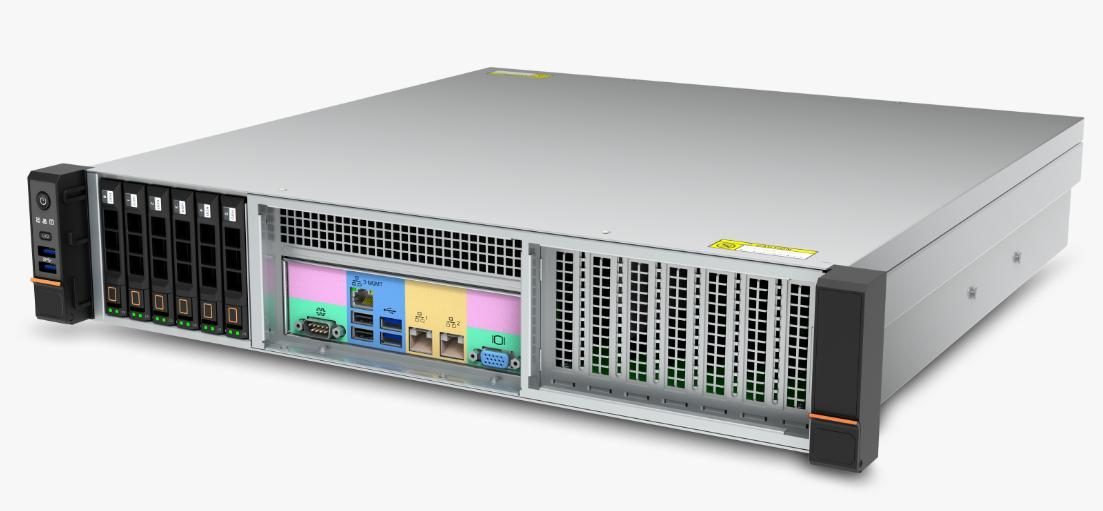
Factory floors, retail stores, and outdoor cabinets demand something very different from a server room. Which environments suit short-depth, wide-temperature, and fanless designs, and how do you choose?
Edge computing differs fundamentally from a traditional data-center environment. A data center offers controlled temperature and humidity, standard racks, and dedicated operations staff; edge nodes may be deployed on factory floors, in retail stores, at ports and docks, or even in roadside cabinets. Changed environmental conditions require a corresponding adjustment in server chassis selection logic.
Moving a standard rack server straight from the data center to an edge site often causes problems: the system is too deep for the low-voltage cabinet, it crashes repeatedly in summer heat, or fans suck dust into the chassis and cause shorts. These aren't quality defects in the equipment itself—they result from not fully considering environmental differences at selection time.
This article compares the key options for edge server chassis, clarifying the three concepts of short depth, wide temperature, and fanless design.
【Environmental Characteristics and Selection Requirements of Edge Scenarios】
Take a typical case: an edge server must be installed in a factory-floor low-voltage cabinet with no air conditioning, summer temperatures above 50 °C, and dust in the air; the cabinet is only 500 mm deep, so a standard 750 mm-deep system won't fit; and there's no dedicated IT staff on site, so the equipment should need little maintenance after installation.
This case brings together the three core requirements for an edge chassis: short depth, wide temperature tolerance, and low maintenance—exactly the weak spots of traditional rackmount chassis.
Edge scenarios are diverse, with different emphases: retail stores care about quiet operation and small size, factory floors about dust and vibration resistance, outdoor cabinets about water resistance and wide temperature. So there's no "one-size-fits-all" standard edge chassis—selection must be based on the specific scenario.
【Short-Depth Structure】
Standard rack servers are mostly 750 to 800 mm deep, while low-voltage and wall-mounted cabinets in edge scenarios are often only 400 to 600 mm deep. The first step in edge chassis selection is to measure the available installation depth, then choose the corresponding short-depth product or a custom chassis.
Short depth isn't simply cutting a chassis shorter. Once depth is compressed, the motherboard, PSU, and drive layout must be rearranged and the airflow redesigned. So a short-depth chassis is usually not a trimmed-down standard product—it needs a dedicated structural design.
When measuring depth, note a few details: whether the cabinet door closes normally, whether there's rear cable-routing space, and whether the power plug and network cables press against the door. Taking these together, the actually required space is usually 50 to 100 mm more than the chassis's stated depth.
【Wide-Temperature Design】
A standard server's rated operating temperature is generally 10 to 35 °C; outside that range, instability may occur. Edge environments may require startup at minus 20 °C, or continuous operation at 60 °C.
Wide-temperature design involves several layers: wide-temp-grade components, enhanced cooling or heating measures, and proper dust and moisture protection. During selection, don't rely only on the word "wide temperature" in marketing materials—clarify the specific temperature range and whether within that range the system merely "can power on" or "can run at full load stably over the long term."
Low-temperature startup is another easily overlooked area. In sub-zero conditions, ordinary hard-drive motors struggle to spin up and electrolytic capacitor characteristics change. Genuinely wide-temperature designs include special handling for cold startup—such as heated startup or wide-temp-grade components. Once the actual environment is defined, the vendor should provide a corresponding solution for these details.
【Fanless Cooling Solutions】
Dust is a hidden hazard for edge devices. Fans draw dust into the chassis, where it accumulates on circuit boards and can eventually cause poor cooling or even shorts. In dusty environments, a fanless design is an effective response.
A fanless chassis usually uses a sealed aluminum-alloy enclosure with large finned surfaces; chip heat is conducted to the shell through thermal pads and dissipated by natural convection. By eliminating the fan—a wear item—this approach excels at dust and vibration resistance and quiet operation, with significantly improved reliability; the trade-off is limited cooling capacity, suitable only for low-power platforms.
Fanless is therefore not a universal solution—it suits harsh environments with modest power draw. Edge nodes with higher compute needs still require fan-based enhanced cooling. The judgment depends on whether platform power matches the enclosure's cooling surface area—generally, fanless cooling capacity is on the order of tens of watts, beyond which careful evaluation is needed.
【Ingress Protection Ratings】
Edge chassis specs often show protection ratings like IP40 or IP65. The two digits after "IP" indicate dust and water resistance respectively, with higher numbers meaning stronger protection. IP65 means fully dust-tight and protected against water jets, suited to dusty or damp environments.
Choose the rating based on the actual environment: IP40 is usually adequate for indoor workshops, while outdoor or wash-down areas need IP65 or higher. Don't pick too low a rating to save money, but don't blindly chase a high rating and waste cost either.
Besides IP ratings, vibration and shock resistance matter in vehicle-mounted and port scenarios. Such metrics usually have corresponding test standards—ask the vendor for test reports during selection.
【Comparison of the Three Solutions】
Solution Suitable Environment Advantages Limitations
Short-depth rack chassis Low-voltage cabinet, wall cabinet Familiar rack form, good expandability Needs dedicated structure, depth limited
Wide-temp ruggedized chassis Workshop, outdoor cabinet Wide temperature range, stable Costs more than standard products
Fanless sealed chassis Dusty, vibrating environments No wear items, dust- and shock-resistant Only for low-power platforms
【The Customization Trend in Edge Chassis】
Putting the above together leads to one conclusion: edge scenarios vary too much for standard chassis to cover them all. Cabinet depth, temperature range, protection rating, and expansion needs differ by project, and in most cases customization based on site conditions is required.
This is the main difference between edge chassis and data-center chassis—the latter are fine as off-the-shelf products, while the former usually must be tailored to the scenario. Customization lets you maximize space utilization and configure protection and cooling to the actual environment; the cost is a longer lead time and higher expense than standard products.
If the number of edge nodes is small, amortized customization cost can be high; but at scale, or when standard products genuinely can't meet environmental requirements, customization is actually the more economical choice.
We've completed many edge and industrial chassis customizations, from short-depth rack cases to fanless sealed systems, and can produce structural designs based on installation space and environmental conditions. If you have an edge node project, send us the cabinet dimensions, ambient temperature, and expansion requirements, and we'll help determine the suitable solution; small-batch prototyping is also supported.