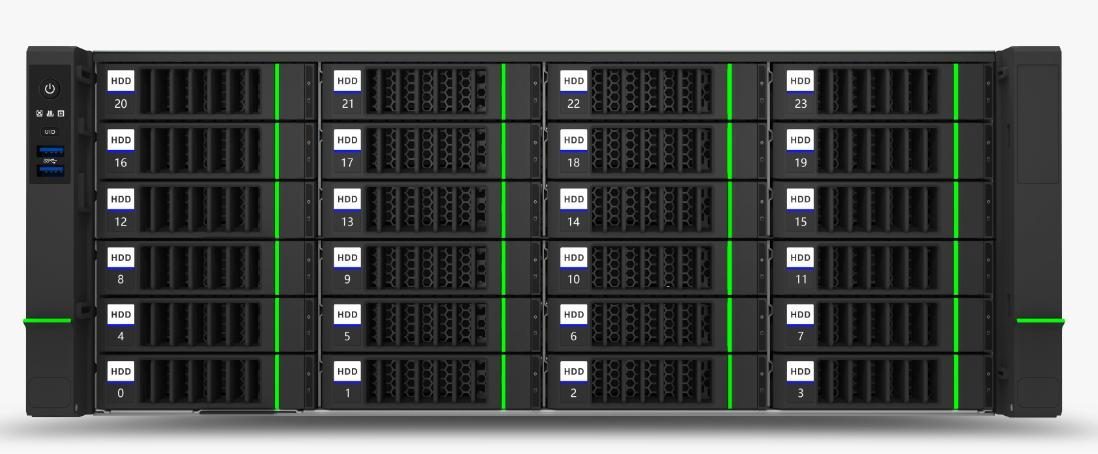
A closer look at the 4U 24-bay hot-swap model: tool-free maintenance, backplane LED indicators, flexible SAS/SATA/NVMe configurations, for NAS, backup, and data-tiering scenarios.
The twenty-four 3.5-inch bays in this 4U storage chassis now all support hot-swap: drive trays carry pull handles for tool-free removal, and a failed drive can be replaced without shutting the system down. Maintenance windows change from "scheduled downtime" to "any time." That is one of the most essential differences between a storage chassis and a general-purpose rackmount enclosure. This article unpacks the design details and the workloads they serve.
【Hot-swap is more than "pullable"】
True hot-swap is a whole system: the backplane isolates power and signal per bay so removing one drive never disturbs its neighbors; pull handles allow one-handed locking and release without tools; fans and drives are modular — a failed module swaps out directly without taking the chassis offline. The lid opens with a tool-free latch, saving real hours in routine inspection and maintenance.
【Backplane and monitoring】
Behind the bays sits a 12Gb/s SAS/SATA data backplane with SGPIO support — when a drive fails, its locator LED lights up on the front panel, and the bad disk is found at a glance instead of hunted down in software. Protocols are configurable per project across SAS/SATA/NVMe, matched through sub-models (direct-attach, Expander, or NVMe), so the capacity-bandwidth combination can be decided after the workload is defined.
【Why 4U】
Twenty-four 3.5-inch bays are a sweet spot for the 4U form factor: double the capacity of a 2U twelve-bay model, with more relaxed cooling and power provisioning; shorter and lighter than a 36-bay chassis, friendlier to rack depth and load limits. The 4U interior also leaves expansion slots — NICs or accelerator cards fit alongside the storage role.
【Workloads】
NAS and private-cloud nodes: many bays and frequent maintenance, where hot-swap and SGPIO localization directly improve operations. Backup and archive: high-capacity sequential writes, where the Expander topology offers the best value. Data-tiering storage: NVMe for the hot tier and SAS for the cold tier, zoned in one chassis.
For combinations of bay count, protocol, and capacity — or to confirm compatibility with a specific motherboard — send us your application and expected drive count, and we will put together the full configuration and quote.